Dewalt Self Laser Level - Complete UK Guide
What is Pulse Mode on a Laser Level? Why UK Builders Need It
Pulse mode on a laser level is the setting that lets the laser work with an electronic receiver, so you can find the beam outdoors, in bright daylight, or over longer distances when the line is no longer visible to the eye. In other words, if you are asking what is pulse mode on a laser level, the simple answer is that it helps your laser level and detector work together for accurate levelling on larger or brighter UK job sites.
TL;DR: Pulse mode changes a laser level from a standard visible beam to a rapid pulsing signal that a compatible receiver can detect. Therefore, it is essential for outdoor use, long-range levelling, and bright conditions. Without pulse mode and a receiver, most cross line lasers become very difficult to use beyond typical indoor distances.
If you have ever bought a professional cross line laser, you have probably noticed a button marked with a “P”, a zig-zag line, or a receiver symbol. However, for many tradespeople across the UK, it remains one of the most misunderstood features on the tool. Yet on site, whether you are grading a driveway, setting out foundations, or transferring levels across a plot, this one function can save considerable time and reduce guesswork.
Based on our testing with Huepar Llav laser levels in typical UK daylight conditions, pulse mode is the feature that turns an indoor line laser into a far more practical outdoor setup when paired with a detector. As a result, instead of relying on seeing the line itself, you rely on the receiver to locate it precisely.
Quick Answer: What Does Pulse Mode Do on a Laser Level?
- It enables receiver use: Pulse mode lets an electronic detector pick up the beam when your eyes cannot see it clearly.
- It improves outdoor usability: In British daylight, this is usually the only reliable way to use a cross line laser outside.
- It extends working range: Indoors you may see the beam at 20 to 30 metres, whereas with pulse mode and a receiver you can often work much farther.
- The line may look dimmer: This is normal and usually means pulse mode is active.
- It suits UK trades: For groundworks, fencing, drainage and site set-out, pulse mode is often essential rather than optional.
How Does Pulse Mode Work on a Laser Level?
Pulse mode works by changing the beam from a steady output into an extremely fast flashing signal. Although that flashing is too quick for the human eye to notice properly, an electronic laser receiver can detect it. Consequently, even when sunlight washes out the visible line, the receiver can still identify where the beam is.
According to guidance commonly followed for Class 2 construction lasers in the UK, visibility and safe operating range depend heavily on ambient light conditions. Indoors this is rarely an issue. Outside, however, bright sunlight dramatically reduces how visible any red or green line appears. That is why pulse mode matters so much for external work.
Why does the line look dimmer in pulse mode?
When pulse mode is turned on, the beam often appears slightly fainter to your eye. This happens because the laser is no longer presenting as one simple continuous visible line in quite the same way. Nevertheless, this slight dimming is normal and does not mean performance has dropped. In fact, it usually means the tool is ready to be read by a detector.
How do laser receivers detect pulse mode?
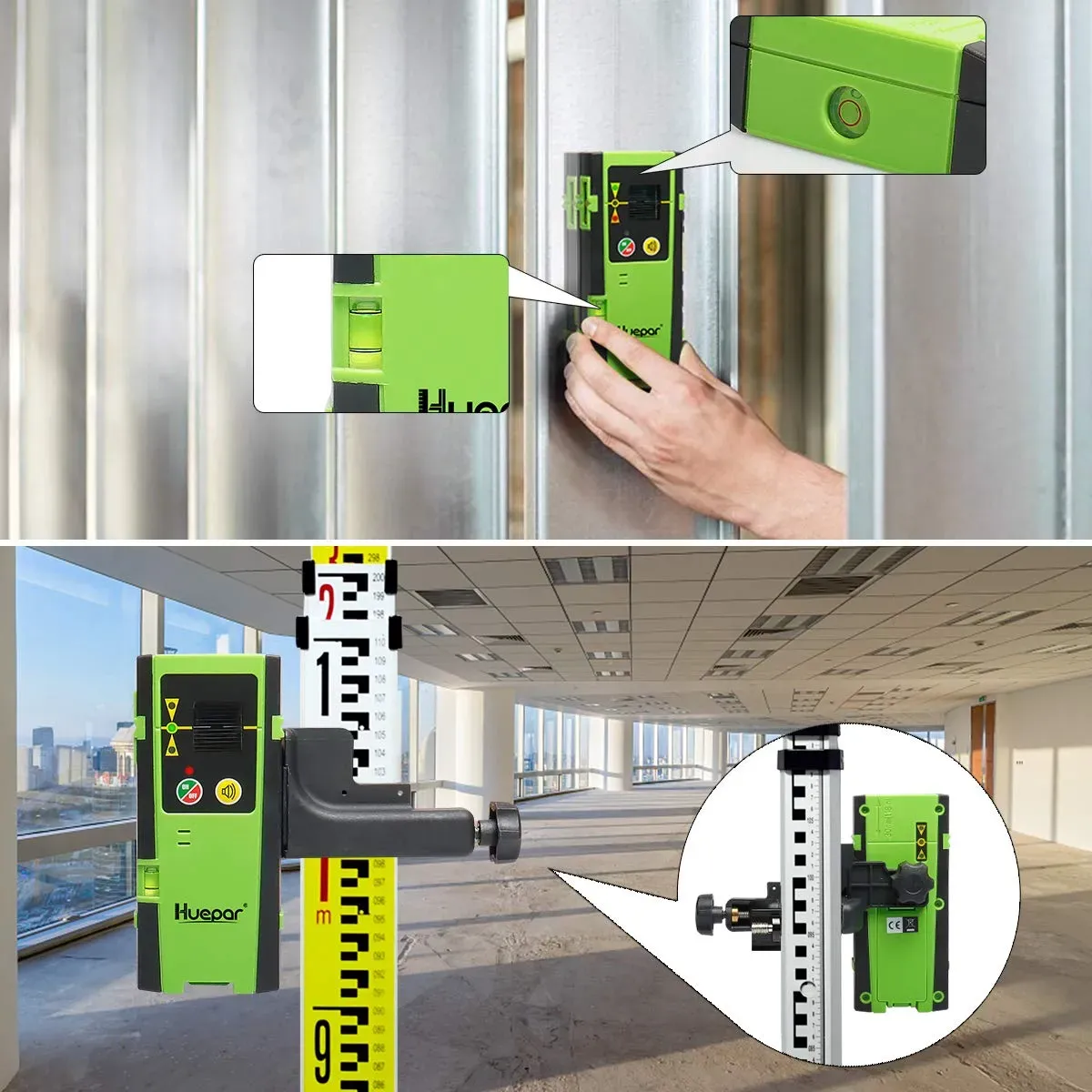
The receiver contains sensors designed to pick up that pulsing signal while filtering out much of the surrounding ambient light. So rather than depending on direct visual visibility alone, it listens for the specific signal pattern from the laser level. Then it gives audible tones and display prompts to show whether you are above, below or exactly on level.
When Should You Use Pulse Mode on a Laser Level?
You should use pulse mode when normal beam visibility is no longer good enough for accurate work. Most commonly, that means outdoors in daylight or whenever your working distance stretches beyond what you can clearly see indoors.
In practice, pulse mode is especially useful in these situations:
- Working outside in bright daylight: If direct sun or strong overcast glare makes the beam hard to see.
- Long-distance levelling: For example when setting out fence lines, checking falls, landscaping or transferring levels across large areas.
- Groundworks and drainage: Where precise reference heights matter but visible lines disappear quickly across open sites.
- Machine control or rod work: When using receivers mounted on staffs or equipment.
- Larger commercial jobs: Where consistency over distance matters more than seeing the line directly.
By contrast, if you are fitting kitchens, tiling bathrooms or carrying out first-fix carpentry indoors at shorter ranges, you will often not need pulse mode at all. Therefore, for internal finishing jobs it may remain switched off unless you are using a detector deliberately.
If you are still deciding whether your setup needs one, see our guide on whether you actually need a laser receiver. Likewise, if visibility outdoors is your main problem, our article on seeing a laser level outside in bright daylight explains your options in more detail.
Can You Use Pulse Mode Outdoors in Sunlight?
Yes — and that is precisely what it is for. On most UK building sites, sunlight makes even bright green beams difficult to follow by eye once distance increases. Therefore, while people often describe pulse mode as an optional feature, for outdoor levelling it is usually essential.
Looking for the right tool? Check the green laser level for full UK specs.
Based on our testing across patios, driveways and open-site set-out work, users typically find that visible-beam performance drops off quickly once ambient light rises. However, once pulse mode is enabled and paired with a compatible Huepar Llav receiver, outdoor work becomes far more reliable and repeatable.
This matters because external jobs rarely happen under ideal lighting. Even typical bright cloud cover in Britain can reduce contrast enough to make lines unreliable at distance. As a result, using pulse mode outside improves both productivity and confidence in your measurements.
Does Pulse Mode Drain Battery Life?
No — not significantly in most real-world use. A common belief on site is that switching on extra functions must mean faster battery drain. However, based on our testing and customer feedback from UK tradespeople using modern lithium-powered units, pulse mode generally has only a minor impact on runtime.
You may notice slightly different power behaviour depending on model and brightness settings. Even so, modern Huepar Llav laser levels are designed for practical all-day working use. Therefore, enabling pulse mode for detector work should not be seen as something that makes your tool impractical through normal shifts.
The key point is this: if pulse mode lets you complete long-range levelling accurately first time rather than rechecking by hand repeatedly, any minimal battery trade-off is usually worth it many times over.
section> sectionthe-smart-al"> <>Why Is Mode Important for UK Builders Trades? <>For many trades,pulse what separates indoor convenience from true site practicality If your includes fencing,,, decking landscaping foundations level transfer around plots being able trust setup outdoors matters greatly than simply having bright-looking lines indoors pAt Hueparlav we see this repeatedly who choose only by brightness claims often discover daylight visibility itself enough Once add compatible however same tool useful far wider jobs Therefore understandingwhat valve working method becoming deciding factor between quick accurate setup repeated manual checking. pAnother point reliability Pulse-and-receiver working removes much ofivity fromelling over distance Instead guessing where faint line ends can reference measurable That consistency helps reduce callbacks speed up set improve confidence multipleatives need work same benchmark around siteppFor buyers alternatives expensive systems practical route A well-matched Hue Llaser plus gives strong performance without forcing users into overered-brand lock-ins making it smart choice builders dependable value in conditions /> section> section id="common-mistakes"> <>What Common Mistakes With Pulse?Mistakes with relatively easy avoid once know what watch Here are issues we often hear about from users newer detector-based levelling: ul> listrongTrying visible alone outside Pulse does make line easier eye direct sun; makes detectable by>Related reads: Leica Laser Level - Complete UK Guide · Green Dewalt Laser Level - Complete UK Guide
Ready to upgrade your site layout with {brand_name}?
Get Yours Now — £58.18