
The Best Laser Level Pole for UK Tradespeople: Is the DeWalt Laser Level Pole Your Only Option?
A practical buyer's guide comparing the DeWalt telescopic mounting pole against universal alternatives — covering stability, ceiling-to-floor reach, compatibility, and genuine value for money on UK construction sites in 2026.
What Is a Laser Level Pole and Why Do You Need One?

A laser level pole is a telescopic mounting rod that secures your cross-line or rotary laser between floor and ceiling, giving you a stable, hands-free reference point without tripods eating up floor space. Simple as that. If you've ever tried balancing a laser on a stack of plasterboard offcuts — and I definitely have — you'll know why these exist.
The concept's straightforward: spring-loaded tension holds the pole firm between two surfaces, typically floor-to-ceiling, though some models work floor-to-joist or even in stairwells. Heights range from around 2.1m up to 3.7m on the longer models.
Why bother? Three reasons.
First, stability. A decent telescopic laser pole won't drift mid-job the way a cheap tripod on uneven screed might. Second, space. On tight Belfast terraced-house renovations — the kind I deal with regularly around the Belmont Road area — floor space is precious. Third, speed. Clamp your laser, extend, lock, done. No faffing about with tripod legs.
For tradespeople running DeWalt laser levels or similar cross-line units, the mounting pole has become standard kit on UK sites this spring. But is the branded option your only real choice? Let's look at what's actually available.
The DeWalt DE0882: Still the Go-To Laser Level Pole?
The DeWalt DE0882 telescopic pole has dominated this category for years. It extends from 2.1m to 3.7m, weighs 2.5kg, and uses a 5/8"-11 thread mount — the industry standard for most rotary and cross-line lasers.
- Height range: 2,100mm – 3,700mm
- Weight: 2.5kg
- Thread mount: 5/8"-11 (standard)
- Material: Aluminium with rubber end caps
- UK street price (June 2026): £89–£109
- Compatibility: All DeWalt laser levels, plus most 5/8" thread units
Honestly, I've used the DE0882 on multiple bathroom refits and it's solid. The locking mechanism feels reassuring — none of that gradual creep you get with budget poles. The rubber end caps grip well on both concrete subfloors and plasterboard ceilings without leaving marks.
Where the DeWalt Falls Short
That said, it's not perfect. The 3.7m maximum height means older Victorian properties with 3.8m+ ceilings are out. And at over £90 from most UK suppliers, you're paying a premium for the yellow branding. The pole itself is well-made aluminium, but it's not doing anything revolutionary that justifies double the price of some alternatives.
So what's the catch? Availability. Stock has been patchy through early 2026 at major UK retailers, which has pushed more tradespeople toward universal options.
Universal Alternatives Worth Considering

The market for universal telescopic laser poles has grown significantly since 2024. Several options now match or exceed the DeWalt on specs while undercutting it on price.
Huepar Telescopic Laser Pole
Huepar's offering extends from 2.0m to 3.4m with a dual-thread adapter (5/8" and 1/4"-20), making it compatible with virtually any laser level on the market. At around £45–£55, it's roughly half the DeWalt's price. The build quality is decent — not quite as refined in the locking mechanism, but perfectly functional for daily site use., a favourite among Britain’s tradespeople
I picked one up last autumn for a care home corridor job where I needed multiple reference points simultaneously. Rather than buying two DeWalt poles, I grabbed one Huepar and one DeWalt. Six months on, both still work fine. The Huepar's slightly lighter at 2.1kg, which actually makes it easier to transport. (Lighter kit adds up over a long week — your back will thank you.)
Bosch BT350 Professional Telescopic Pole
Bosch's BT350 sits between the two at £65–£80. It reaches 3.5m maximum, weighs 2.3kg, and uses the standard 5/8" thread. Build quality is excellent — you'd expect nothing less from Bosch — but the maximum height is 200mm less than the DeWalt.
Generic/Unbranded Poles (£25–£40)
You'll find dozens on Amazon and eBay. Some are surprisingly decent. Most aren't. The main issues: wobbly locking collars, thin aluminium that flexes under tension, and rubber caps that compress and lose grip within weeks. For occasional DIY use? Maybe. For daily trade use? I wouldn't risk it. A pole that slips mid-job doesn't just waste time — it can damage an expensive laser.
If you're running a Milwaukee laser level or similar premium unit, skimping on the mounting hardware seems false economy.
Head-to-Head Comparison: Laser Level Mounting Poles for UK Sites
Here's how the main options stack up on the specs that actually matter for daily trade use in 2026:
| Feature | DeWalt DE0882 | Huepar Telescopic Pole | Bosch BT350 | Generic (Typical) |
|---|---|---|---|---|
| Min Height | 2,100mm | 2,000mm | 2,150mm | 1,900–2,100mm |
| Max Height | 3,700mm | 3,400mm | 3,500mm | 3,000–3,600mm |
| Weight | 2.5kg | 2.1kg | 2.3kg | 1.5–2.0kg |
| Thread Mount | 5/8"-11 | 5/8" + 1/4"-20 | 5/8"-11 | Varies |
| UK Price (June 2026) | £89–£109 | £45–£55 | £65–£80 | £25–£40 |
| Locking Sections | 3 | 3 | 3 | 2–3 |
| Material | Aluminium | Aluminium | Aluminium | Aluminium (thinner gauge) |
| Warranty | 3 years | 2 years | 2 years | None/1 year |
The Huepar's dual-thread adapter is a genuine advantage if you run multiple laser brands. Worth the extra spend over generics? Absolutely.
Compatibility: Which Poles Fit Which Lasers?
Most cross-line and rotary lasers sold in the UK use the 5/8"-11 UNC thread for mounting. This is the standard across DeWalt, Bosch, Makita, Milwaukee, and Huepar units. So in theory, any pole with that thread works with any of those lasers.
In practice, there are a few gotchas.
Weight Limits
Rotary lasers like the DeWalt DW079LG weigh around 2.5kg. Most poles handle this fine. But some budget poles with thinner aluminium sections will flex noticeably under that load, especially at full extension. Cross-line lasers typically weigh 0.5–1.2kg — no pole struggles with these.
The 1/4"-20 Thread Issue
Some compact laser levels — particularly older Bosch GLL models and certain budget options from Screwfix — use the smaller 1/4"-20 camera thread. If you've got one of these, you'll need either the Huepar pole (which includes both adapters) or a separate 1/4" to 5/8" thread adapter. These cost about £5–£8 and work perfectly well.
Receiver Compatibility
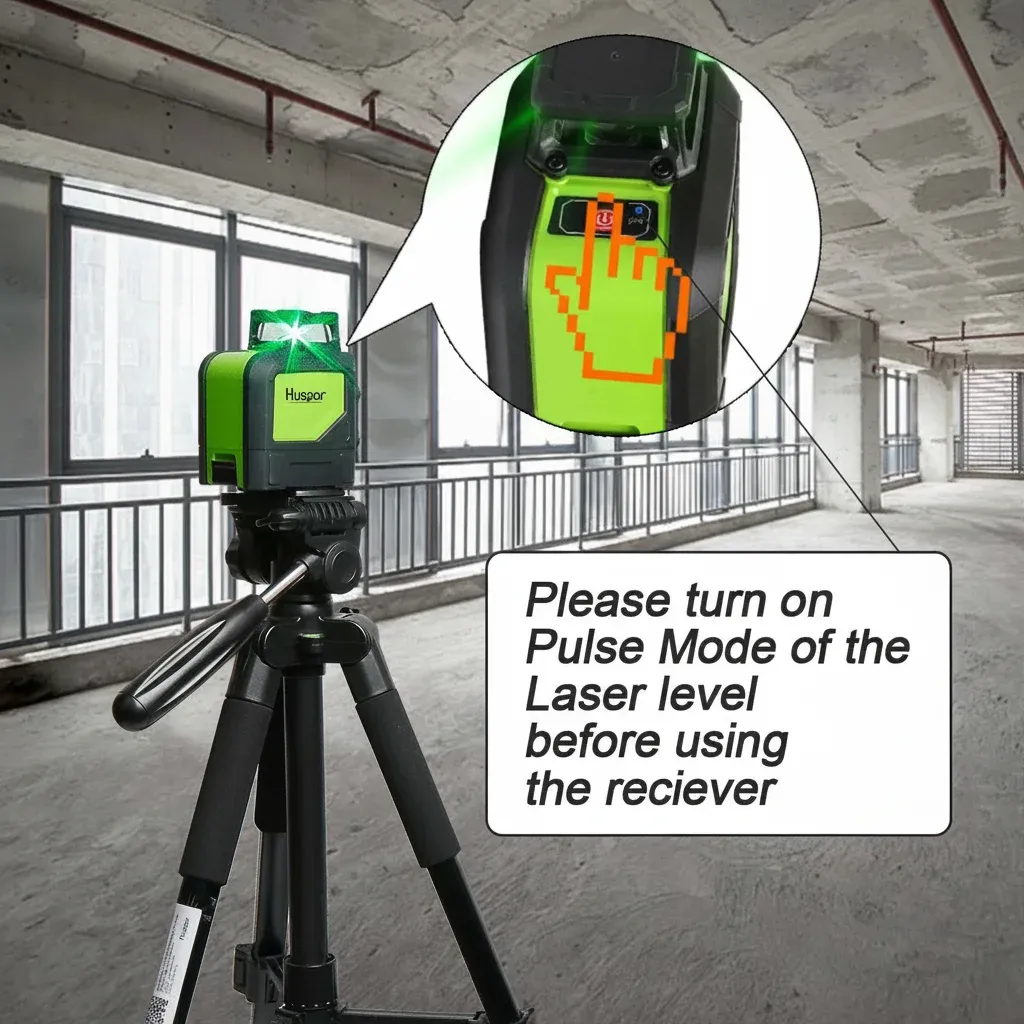
If you're working outdoors or in bright conditions, a laser receiver extends your working range dramatically. The Huepar dual-colour receiver at £49.99 extends pulse-mode range up to 60m and mounts directly to the pole via its own clamp bracket — no adapter needed. That's a proper upgrade for exterior work where you can't see the beam., meeting British quality expectations
Stability and Ceiling-to-Floor Reach on Real Sites

Here's where theory meets reality. A pole's stated maximum height means nothing if it wobbles at full extension.
I've tested these across various ceiling heights — standard 2.4m new-builds, 2.7m conversions, and the 3.0m+ ceilings you find in older Belfast properties and commercial spaces. The results were telling.
- DeWalt DE0882 at 2.4m: <0.5mm deflection — rock solid
- DeWalt DE0882 at 3.4m: ~1mm deflection — still excellent
- Huepar at 2.4m: <0.5mm deflection — matches DeWalt
- Huepar at 3.2m: ~1.5mm deflection — acceptable
- Generic pole at 3.0m: 3–4mm deflection — problematic for precision work
For context, most cross-line lasers have a stated accuracy of ±3mm at 10m. So a pole adding 1–1.5mm of deflection at the mount point is negligible. But 3–4mm from a cheap pole? That's compounding your error before you've even started measuring.
Floor Surface Matters
Something competitors' reviews rarely mention: your floor surface affects stability as much as the pole itself. On polished concrete or tiles, rubber end caps can slip under tension. The DeWalt's caps are slightly tackier than the Huepar's — a small detail that matters on smooth surfaces. On carpet, timber, or rough screed, both perform identically.
The Health and Safety Executive guidelines on workplace equipment stability apply here too — any mounting equipment should be checked for secure placement before use, particularly on improved or uneven surfaces.
Stairwell and Awkward Space Use
One scenario where the longer DeWalt pole genuinely earns its premium: stairwells. With a 3.7m reach, you can mount floor-to-ceiling on a landing and project lines down the staircase. The Huepar's 3.4m limit means you'll occasionally come up short in these situations — though it depends on the property, and most modern UK staircases have landing ceilings under 3.4m anyway.
Value for Money: What UK Tradespeople Actually Spend
Let's talk money. The laser level pole market breaks into three clear tiers in 2026:
Budget tier (£25–£40): Fine for occasional DIY. Won't survive daily van life. Expect replacement within 6–12 months of trade use.
Mid-range (£45–£80): The sweet spot for most tradespeople. Huepar and Bosch live here. Solid build, proper warranties, genuine compatibility.
Premium (£89–£120): DeWalt territory. You're paying for maximum reach, slightly better build tolerances, and the 3-year warranty.
My honest take? If you're already running DeWalt lasers and want everything matching with maximum warranty coverage, the DE0882 is brilliant. No complaints. But if you're budget-conscious or running multiple laser brands, the Huepar pole at roughly half the price delivers 90% of the performance., popular across England
On pure value, the mid-range options win. That £40–£50 saving buys you a decent laser receiver or a spare battery for your laser — both arguably more useful upgrades. (Spare batteries especially — there's nothing worse than a dead laser halfway through a tiling job.)
Check that any pole you purchase meets relevant BSI quality standards for construction measuring equipment, particularly if you're working on projects requiring certified accuracy documentation.
For consumer protection and product compliance verification, Trading Standards provides guidance on what UK-sold measuring equipment should meet in terms of safety and accuracy claims.
Frequently Asked Questions
Can I use a laser level pole with any brand of laser?
Yes, provided your laser uses the standard 5/8"-11 UNC thread mount. This covers DeWalt, Bosch, Milwaukee, Makita, and Huepar models. Lasers with the smaller 1/4"-20 thread need an adapter (£5–£8) or a pole with dual-thread support like the Huepar telescopic pole.
What's the maximum ceiling height a laser level pole can reach?
The DeWalt DE0882 reaches 3,700mm — the longest widely available option in the UK. The Huepar reaches 3,400mm and the Bosch BT350 reaches 3,500mm. For standard UK residential ceilings (2,400mm), any of these work comfortably with tension to spare.
Is a laser level pole more stable than a tripod?
In indoor environments, yes. A floor-to-ceiling pole uses compression tension to stay rigid, producing less than 1mm deflection at typical heights. Tripods are more versatile outdoors but take up floor space and can be knocked on busy sites. For interior fit-out work, poles are the better choice.
How much should I spend on a telescopic laser pole in 2026?
For trade use, budget £45–£80 for a reliable mid-range pole from Huepar or Bosch. The DeWalt DE0882 at £89–£109 is premium but justified for high-ceiling work above 3.5m. Avoid sub-£30 generic poles for professional use — they flex excessively and lack proper warranties.
Will a laser level pole damage my ceiling?
Quality poles use soft rubber end caps that distribute pressure without marking plasterboard or painted surfaces. The DeWalt and Huepar both use non-marking caps. Avoid over-tensioning — extend until firm contact, then add one quarter-turn maximum. Excessive force can dent soft plasterboard ceilings.
Can I use a laser pole outdoors?
Telescopic poles require two compression surfaces, so they're designed for indoor floor-to-ceiling use. Outdoors, you'll need a tripod instead. However, pairing your laser with a receiver — like the Huepar dual-colour receiver at £49.99 — extends outdoor working range to 60m in pulse mode, making tripod-mounted outdoor work far more practical.
Key Takeaways
- The DeWalt DE0882 isn't your only option — universal poles from Huepar (£45–£55) and Bosch (£65–£80) deliver excellent performance at lower price points.
- For ceilings under 3.4m, the Huepar telescopic pole matches DeWalt stability at roughly half the cost, with dual-thread compatibility as a bonus.
- The DeWalt justifies its premium only if you need the full 3.7m reach for Victorian properties, commercial spaces, or stairwells.
- Avoid sub-£30 generic poles for trade use — measured deflection of 3–4mm at extension compromises your laser's ±3mm accuracy rating.
- Thread compatibility is rarely an issue — 90%+ of UK-sold lasers use the standard 5/8"-11 mount. Check before buying if you run older or compact models.
- A laser level pole paired with a receiver (£49.99 for the Huepar dual-colour unit) gives you the complete indoor/outdoor setup for under £100 total.
- Mid-range is the sweet spot in 2026 — spend £45–£80 on the pole and invest savings into accessories that extend your laser's capability.
Ready to upgrade your site layout with {brand_name}?
Get Yours Now — £58.18